
We are thrown into an alien world, with mirror neurons to guide us. Completely helpless to caregivers in an environment we can’t control, we quickly learn to react with the few powers we have. For some reason, we are fragile and dependent, only able to survive within fine-tuned constraints. We need attention. We need stimulation. We need air. We need food and water. We need some sort of environment to keep our bodies operational. Why do we need these things? We don’t know, because we are too focused on trying to get our needs met to consider why we are needy in the first place.
And yet, all the while, there is an aspect of us that transcends these needs. It is the most familiar aspect. It is the aspect we lose sight of. We may even forget it exists. Yet it is the aspect that allows us to even have a perspective at all. It is that aspect of which we can ask, “Why does anything exist?” “What am I?” “How am I here?” “Where did I come from?”
Our “aware” aspect seems different than the world of shape and texture we experience and mimic with our mirror neurons. It feels strangely untouchable. Timeless. Mysterious. What is this feeling of conscious awareness? How does it relate to the world we access through our physical senses?
Strangely, the most familiar and accessible part of ourselves remains invisible to us until we do something (or until something “happens” to us). We have to realize that we are not what we see externally.
So, how do we achieve this level of self-awareness? Is it inevitable? Is it earned? Is it attained through an exercise of virtue? Is it attainable through esoteric practices or rites of passage? And when do we know we have achieved it? Perhaps the precursors of self-realization will always remain a mystery. And perhaps the angle of perspective will always leave room for ambiguity regarding how self-aware any particular conscious being is. Regardless, the project of becoming more self-aware yields great satisfaction even if an absolute gradation of achievement is difficult (or impossible) to define.
The benefits of self-realization are unique in nuance, yet universally felt. You gain the ability to align yourself to a diverse landscape of options. You see more clearly what you want. You tap into your power and will more easily. Your confidence and clarity feels more effortless. You start to feel as though you are the sculptor of your experience more than a victim of it. You more clearly sense the connection between your choices and outcomes. You interpret situations and realities surrounding you as something to wield rather than as something to fight against. Your nervous system relaxes. You become more calm and centered. You move more slowly and get more done. You become the sovereign self you were always meant to be.
The truth is, not very many humans are operating on this level. Even those who tap into this way of being occasionally divert their attention to old patterns. The illusion of the world, with its psychological triggers and overlays, is dramatic. It grabs attention. It is loud. It feels serious. It can even feel exciting, in a certain way. But operating inside the attractions of the world without self-awareness is like living life strapped to a roller coaster. All you experience is the never-ending ride. Your experience leads you to conclude that life is fundamentally a series of jostles, headaches, and nausea that never ends. It rings true to your experience, so you believe it. But it is not the way life has to be.
When we are absorbed in our experience of the external world, we will attempt to solve all our problems from within it. We have a problem, we experience pain, or we are unhappy with our circumstances, and so we seek ways of defeating, undermining, hiding from, or strategizing against the realities we don’t like. We feel crushed when we don’t succeed. We want to be rescued when we feel overwhelmed. We feel energized if we find our edge and successfully climb our way to the top. All the while, what is unconscious to us is that we are assuming the world is real, the world is big, and the world is outside of us. We act within the world’s rules, trying to bend reality in our favor.
And no wonder. Everyone we see is doing the same thing. Survival. Zero-sum-games. Finite against the infinite. That is all we know. If we have only lived life on a roller coaster, we don’t know that beaches, deserts, forests, and mountains exist. We can’t intend to create an experience for ourselves that we don’t know is possible. And so, we naively recreate what we know. We get stuck in cycles of warfare instead of innovation. We take a side and fight because we think it is better than the alternative. We build entire systems in reaction to problems we want to avoid while ignorantly embedding new problems into our design. We think we are fixing the world, but in actuality, we are a groomed servant of it. We think we are making progress when we move through a psychological progression that others have experienced before us. We are moving in cycles, not understanding the nature of our predicament. We are trying to escape problems to become happy, but happiness always seems to elude us.
So here we are again with a dilemma: how do we move beyond what we know? How do we push into uncertainty without knowing what we are looking for? Where does the inspiration come from to seek for new pieces to the puzzle, rather than simply attempting to put the old ones together? How do we gain a higher perspective to transcend our current limitations?
Ironically, simply defining the question orients us to the solution.
Understanding the way the current world works empowers you to become a conscious architect of a world you want to live in, rather than just surviving in a world you inherit that is fundamentally outside your control. By understanding the mechanics of interactions between the internal and external worlds, you gain the power to become a conscious creator.
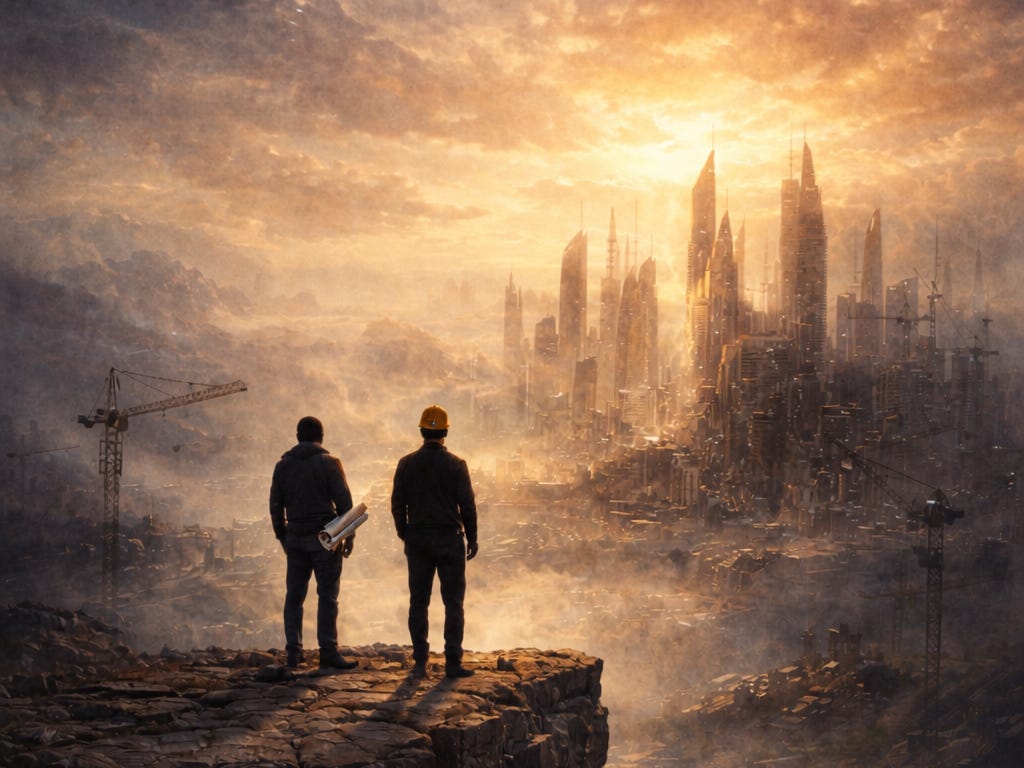
My proposal is this: In order to create a world you want, you must first understand who you are, then you must understand what you want, and finally, you must understand the fundamental aspects of the world you presently see. World-building is a project for an architect, not a medic. A medic simply tries to fix and restore what is already well defined. A medic tries to fix the world. A medic attempts to heal the world to restore it to its original state. And architect, on the other hand, sees the world as a perfect canvas for creation. The architect accepts the world as it is, and then casts a vision for what it could become next. The architect must understand fundamentals and tap into purpose in order to design structures that facilitate something new. The architects create the new definition of what “the world” will become.
When architects are reduced to medics, they feel misaligned. Their misalignment causes pain. If you sense that certain world systems guarantee your enslavement, you will naturally become unhappy. You cannot fix a system that is fundamentally powered by usury. If you seek answers to deep questions and receive blank stares and empty responses in return, you naturally become disillusioned. You cannot redeem a system that operates through blind, hierarchical control. If your probing into the depths of reality unearths deep fears and tragedy, you may very well become depressed, apathetic, or cold. You cannot change what reality is at its foundation. Even God cannot do that.
Your depression, your anxiety, and your frustration in these cases are signs of your new-formed alignment, not of a defect. You are discovering what you will not tolerate. You are seeing clearly what will not work for you. You have lost motivation to continue playing a game that does not lead you toward what you want.
It would be easy to rest in the role of a skeptic or a hermit, forever withdrawing your creative inspiration from humanity’s shared reality. Why would you contribute if people don’t listen? Why would you speak if people don’t respect you? Why would you try to get what you want if reality is ultimately indifferent?
I am here to offer you the designs of a bridge. There is a miserable, unaligned reality on one side, and there is a brilliant, beautiful reality on the other. You might not know whether what you want exists. Right. It might not. That is why you must build it. You might not know whether it is possible to build. Right. That’s why you must try.
To build takes effort. To complain, wallow, nitpick, and hide does not. You thought reality was impossible to survive. I am here to remind you it is not. You are still here, aren’t you? Can you have what you want? Maybe not, but what if you never try? Is chasing desire a trap? Perhaps it is, but until you take action, how will you find out? Is reality ultimately meaningless? How could it be, if you are able to write your story of meaning right now as you consider what you will do in the face of the fear of ultimate meaninglessness?
If you are relate to the wrestling I have described, then you, my friend, are an architect of the new world. Your journey is already underway. You’ve gotten education and training from life experience, investigation, and personal reflection. But you have yet to be initiated. Now, you have a choice. Will you fight with the systems that exist? Will you hide away from the world? Or will you take your chances in the void? Will you try to manipulate what is, or will you risk designing a version of what could be using resources you haven’t even discovered yet?
Don’t get lost in the noise and confusion. Get clarity and orientation. Get self-aligned. Embody your sovereignty. And then use your power to build the world you want.
If this resonates with you, I encourage you to subscribe to these articles. There are two main challenges people like you encounter: (1) they don’t see how to invest their energy into creative opportunities that are self-aligned, and (2) they never find a tangible, real community that supports them. Solutions to these challenges are being constructed right now. Stay with me, and we will get through this together. A new world awaits. Let’s design it, architects.